 Skip to content
Exploring the beauty and history of St. Augustine during Fourth of July weekend with a newborn and a short road trip stop.
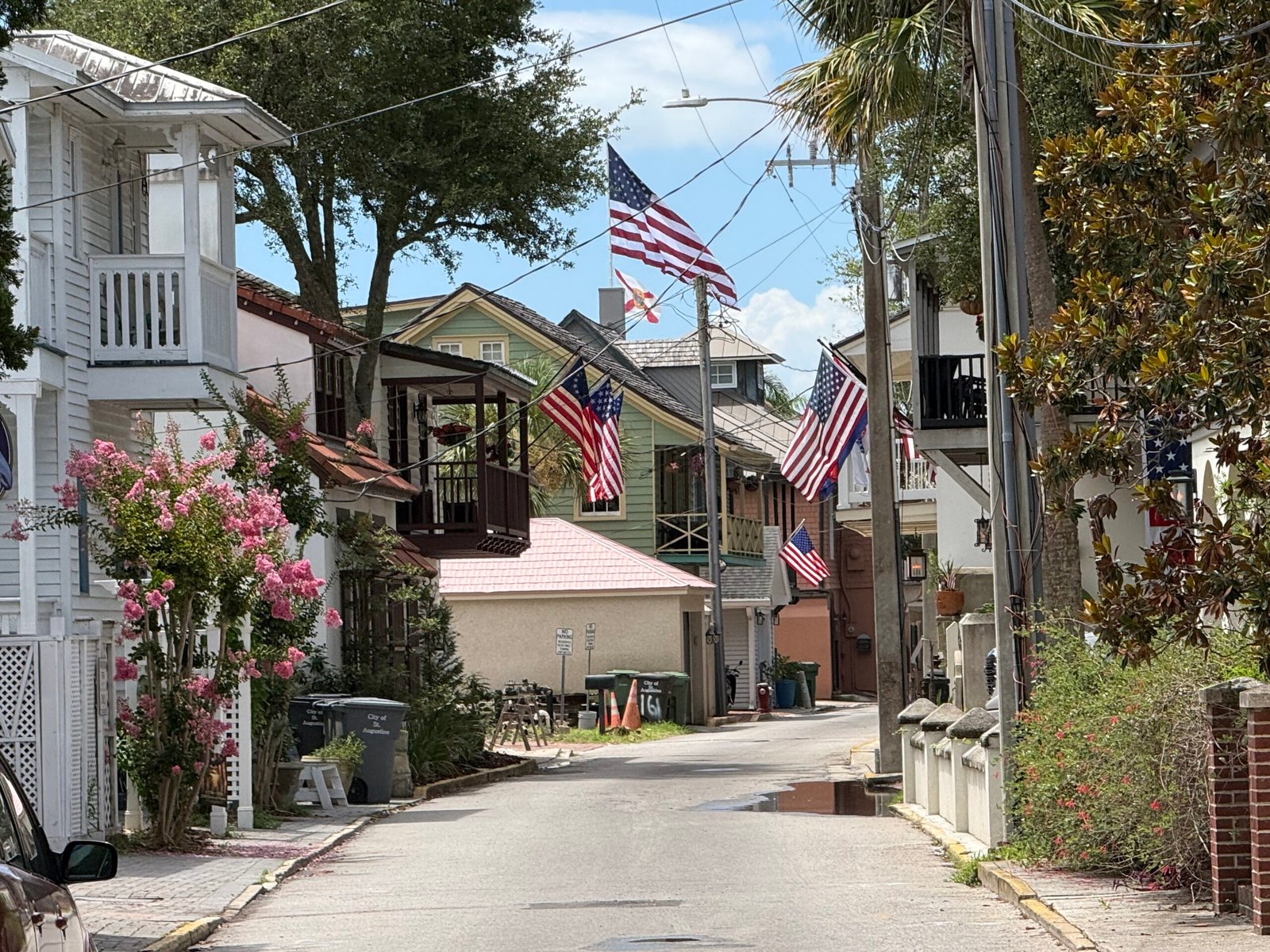
St. Augustine is one of those Florida cities that feels different the moment you arrive. It is historic, walkable, coastal, and full of buildings that make you slow down and look twice. We visited during Fourth of July weekend, so American flags were everywhere – hanging from balconies, storefronts, historic buildings, and tucked along the streets. It gave the city an even more classic, patriotic feel, especially in a place with so much early American and Spanish colonial history.

We only spent one night in St. Augustine, staying at Spark by Hilton St. Augustine Historic District. For a short stop, the location worked well because the hotel is in downtown St. Augustine and close to the main historic areas. Hilton lists it as about half a mile from both Castillo de San Marcos National Monument and St. George Street, which makes it convenient if you want to explore without committing to a long drive across town.
Since we were traveling with our newborn and continuing to Savannah later that day, we kept this visit simple. Instead of trying to see everything, we focused on walking through the historic district, seeing the architecture, grabbing lunch, and getting a feel for the city.
One of the first things that stood out was Castillo de San Marcos. We did not tour inside during this visit, but even driving slowly past it was impressive. The fort sits along the water and immediately gives St. Augustine its historic identity. Castillo de San Marcos was built by the Spanish to defend Florida and the Atlantic trade route, and it is known as the oldest masonry fortification in the continental United States. Construction began in 1672 and was completed in 1695, replacing earlier wooden defenses that had protected St. Augustine since its founding.


That history matters because St. Augustine was not just another coastal town. The city was officially founded on September 8, 1565, by Pedro Menéndez de Avilés, making it the longest continuously occupied European-founded settlement in what is now the continental United States. Walking through the city, you can feel that long timeline in the layout, the old streets, the fort, the Spanish influence, and the later Gilded Age buildings.
We parked along Avenida Menendez near the Black Raven pirate ship area and started walking around the harborfront. The Black Raven is docked at the St. Augustine Municipal Marina on Avenida Menendez, and even if you are not taking the cruise, the area is a fun place to start because you get the waterfront views right away. From there, we walked near the mini golf course, saw the statue of Juan Ponce de León, and continued toward Plaza de la Constitución.


The plaza is one of the most important public spaces in St. Augustine. It has been part of the city since the Spanish colonial period, and some sources date its layout back to 1573. Its name comes from the monument honoring the Spanish Constitution of 1812. Today, it is a shaded central gathering space surrounded by historic buildings, restaurants, shops, and landmarks. During Fourth of July weekend, it felt especially fitting to walk through a plaza connected to centuries of political and civic history while flags were displayed all around the city.
After the plaza, we continued toward Flagler College, which was one of the most beautiful parts of the walk. The campus is centered around the former Hotel Ponce de León, built by Henry Flagler in 1888 as one of his luxury resorts along Florida’s east coast. The building is now Ponce de Leon Hall and is considered a National Historic Landmark. Flagler College notes that it was also the first major poured-in-place concrete building in the United States.

The architecture alone makes it worth walking by. The red roofs, towers, ornate details, and Spanish Renaissance Revival style make the building feel more like a European palace than a college campus. Even if you do not take a formal tour, the exterior is stunning and adds another layer to St. Augustine’s story. The city is not only Spanish colonial; it also reflects Henry Flagler’s role in turning Florida’s east coast into a winter destination during the Gilded Age.
Nearby, we walked through Parque de Menéndez, the area in front of City Hall. The park honors Pedro Menéndez de Avilés, the founder of St. Augustine. According to the City of St. Augustine, the area was named Parque de Menéndez in 1978, and the statue there is a replica of one in Avilés, Spain. It is a smaller stop, but it connects directly back to the city’s founding and the Spanish influence that shaped the area.


From there, we made our way to the Lightner Museum courtyard. This was one of the prettiest spots we walked through. The Lightner Museum occupies the former Hotel Alcazar, another Gilded Age resort hotel commissioned by Henry Flagler. The courtyard is beautiful, with historic architecture, archways, greenery, and a peaceful feel that makes it worth visiting even if you do not have time to go inside the museum. It was one of those places where you can immediately understand why people love photographing St. Augustine.


We then wandered toward the backstreets and made our way down Avilés Street. This street is often described as the oldest street in the United States, with archaeological finds dating back to the early 1600s beneath its brick paving. It has a quieter feel than some of the busier tourist streets, with art galleries, restaurants, historic buildings, and old brick underfoot. For a short visit, Avilés Street was one of our favorite areas because it felt charming without being overwhelming.
For lunch, we stopped at Forgotten Tonic on Avilés Street. The inside was beautiful and had a cozy, historic-district feel while still being modern. I ordered the Caesar salad without anchovies and added tofu on top, plus a side of truffle fries. Katie ordered a burger. Forgotten Tonic describes itself as a neighborhood restaurant and cocktail bar in St. Augustine’s historic arts district, serving modern American comfort food. The truffle fries were also listed on their menu as a side, and they were a great add-on after walking around in the heat.


After lunch, we stopped at Peace Pie for dessert. We had what we described as a banana pudding ice cream cookie sandwich, but the verified menu name appears to be Banana Cream. Peace Pie lists Banana Cream as one of its flavors, made with vanilla ice cream, banana butter, vanilla custard, and graham cracker cookies. It tasted exactly like the kind of cold, sweet dessert you want on a hot Florida day – creamy, refreshing, and easy to eat while walking around.

As we continued through the side streets, we passed so many historic buildings that captured the age and beauty of St. Augustine. One that stood out was the Victorian House Bed & Breakfast, which perfectly represented the city’s charm. St. Augustine has a way of blending Spanish colonial history, Gilded Age architecture, old brick streets, waterfront views, and small local businesses all within a walkable area.

Because it was extremely hot and we were traveling with our newborn, we did not try to push the day too far. That ended up being the right choice. St. Augustine is the kind of city where you could easily spend a full weekend, but even with only half a day, we still felt like we got a meaningful taste of it.
For us, this stop was not about checking off every attraction. It was about slowing down, walking through history, seeing the fort from the road, admiring the architecture, eating somewhere local, grabbing a memorable dessert, and continuing with a better appreciation for one of Florida’s most historic cities.
If you are planning a quick stop in St. Augustine, especially during a road trip, the historic district is very doable in a few hours. Park near the waterfront, walk toward the plaza, continue to Flagler College and the Lightner Museum, wander down Avilés Street, and leave time for food. Even a short visit can give you a strong sense of why St. Augustine is one of the most unique places in Florida.




Leave a Reply