 Skip to content
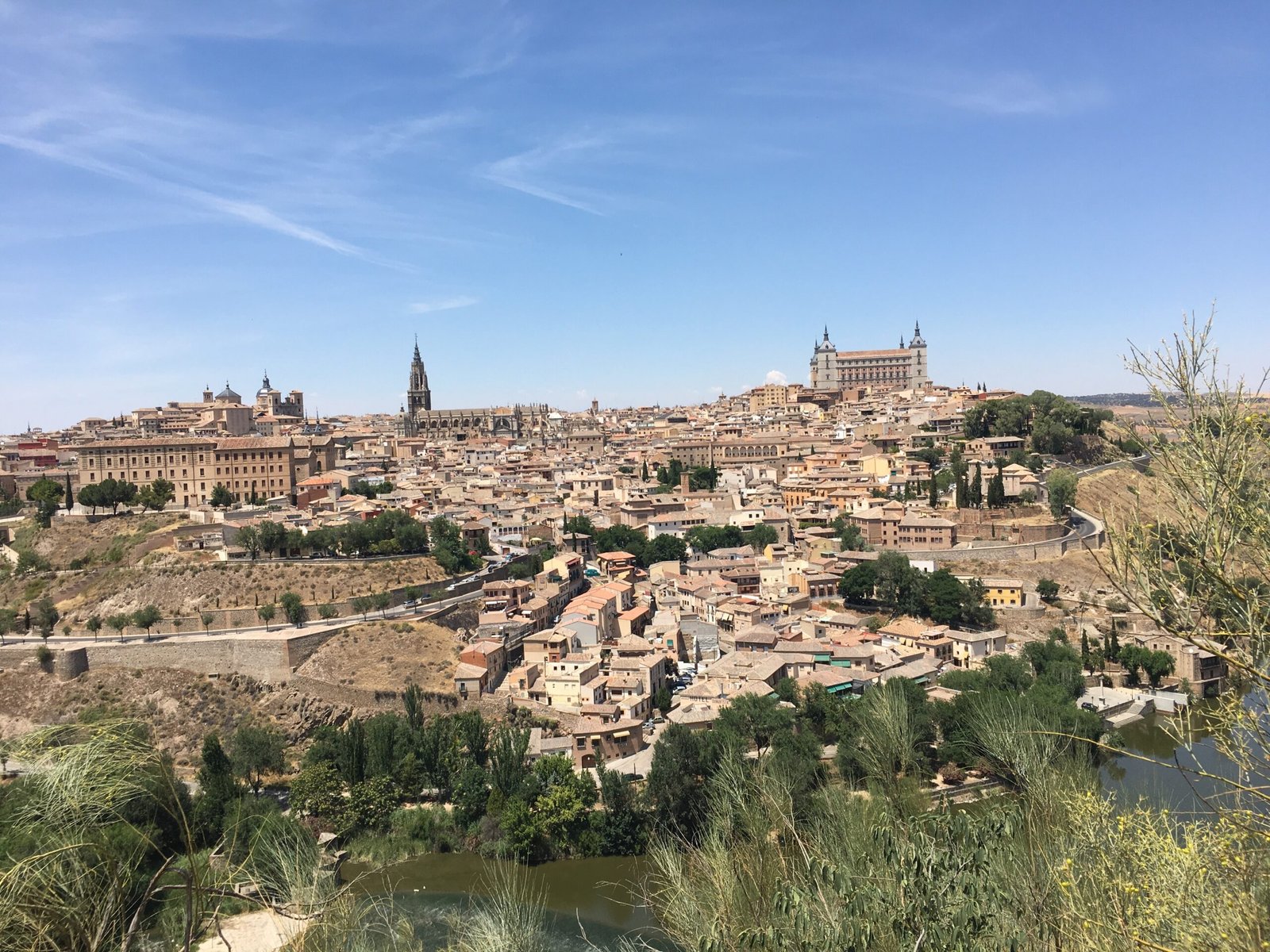
A summer visit through Toledo’s historic streets, from the Tagus River and Puente de San Martín to Toledo Cathedral, El Greco’s El Espolio, and the city’s famous sword-making tradition.
Toledo, Spain, is one of those places that feels like it was built from layers of history rather than planned on a map. Sitting high above the Río Tajo, or Tagus River, the city has the kind of view that immediately makes you understand why it has been important for so many centuries. Toledo has been shaped by Roman, Visigothic, Islamic, Jewish, and Christian history, and because of that, it is often called the “City of Three Cultures.” That name refers to the long historical presence of Christians, Muslims, and Jews, whose influence can still be seen in the city’s architecture, streets, religious buildings, and traditions.
We visited Toledo in the summer, and the heat was no joke. Our tour guide even advised us not to stand still too long because the heat was known to get so intense that it could soften or even melt the soles of shoes against the walkways. Whether that was a warning, a little local exaggeration, or both, it definitely made the point clear: Toledo in the summer is hot. The sun reflects off the stone streets and buildings, and the narrow walkways can feel like they are holding centuries of warmth inside them.
Seeing Toledo from Across the Tagus River


Before we entered the city itself, our bus parked outside the historic center near the Río Tajo. This ended up being one of the best first impressions we could have had. From a distance, Toledo looks almost unreal. The city rises above the river on rocky ground, with old stone walls, towers, and buildings layered together across the hillside.
It is the kind of view that makes you stop for a second before taking photos because you are trying to take in how much history is sitting in front of you. The Río Tajo is an important part of Toledo’s landscape. It curves around much of the old city, helping create the dramatic natural setting that made Toledo easier to defend in earlier centuries.
The river does not just sit beside the city; it helps frame the entire view. Seeing Toledo from afar first made entering the city feel even more special.
Crossing the Puente de San Martín

To enter the city, we crossed the Puente de San Martín. This medieval bridge is one of Toledo’s most recognizable entrances and stretches across the Tagus River on the western side of the city. The bridge has existed in some form since the Middle Ages, although it was damaged during conflicts and later rebuilt under Bishop Pedro Tenorio.
Walking across it felt like the perfect transition from seeing Toledo from afar to stepping into the city firsthand. The bridge gives you one last wide view of the river and the city before you enter the narrow, winding streets. It felt like we were walking out of the present day and into a place where every building had a story.
Walking Through Toledo’s Historic Streets

Once inside, Toledo immediately felt different from other cities we had visited. The buildings looked like they had been placed almost randomly, but at the same time, every wall, balcony, and doorway felt like it belonged exactly where it was. Nothing felt overly polished or modernized. Instead, the city felt lived in.
The streets twisted and climbed, sometimes opening into small plazas and sometimes narrowing into shaded walkways where people were simply going about their day. That was one of my favorite things about Toledo. Even though it is a major tourist destination, it still felt alive beyond tourism.
Walking through the streets, we saw locals moving through their daily routines, shops opening their doors, people talking, and visitors trying to navigate the maze-like layout. Toledo is not a city that feels like it was preserved only to be looked at. It feels like a city that has continued living through every era of its history.
Summer Heat, Markets, and Shaded Streets


Before reaching the cathedral, we passed through market streets where cloth coverings were stretched overhead to create shade. This made such a difference in the summer heat. Some areas also had misters, which helped cool the air as people walked through.
It gave the streets a practical beauty. The fabric above us softened the sunlight, the shops added color and movement, and for a few moments, it felt like the city had created its own way to survive the heat.

The summer heat in Toledo is definitely something to keep in mind if you are planning a visit. Comfortable shoes, water, sunscreen, and breaks in the shade are a must. The city is beautiful, but the stone streets and hills can make the heat feel even stronger.
Visiting the Primatial Cathedral of Saint Mary of Toledo

Our first major stop was the Primatial Cathedral of Saint Mary of Toledo, often called Toledo Cathedral. This cathedral is one of the most important Gothic cathedrals in Spain and one of the most impressive churches we visited during our trip.
Construction began in the 13th century after the Christian reconquest of Toledo, on the site of the city’s former main mosque. It became the seat of the Archdiocese of Toledo, historically one of the most powerful religious centers in Spain.
Going inside Toledo Cathedral was completely different from the bright, hot streets outside. The cathedral’s interior felt cooler, quieter, and massive. Everywhere you looked, there was detail: stonework, stained glass, chapels, carvings, gold, paintings, and architectural features that made it difficult to know where to focus first.
It is one of those places where you can tell the building itself was meant to communicate power, faith, and artistry all at once.

The Transparente Altar

One of the most memorable features inside the cathedral was the Transparente. The Transparente is an 18th-century Baroque masterpiece created by Narciso Tomé. It sits behind the main altar and was designed to use natural light in a dramatic way.
A skylight was opened above it so that sunlight could pour down onto the sculptural altar area, creating the effect of divine light entering the cathedral. The name Transparente comes from the way light passes through the structure and illuminates the tabernacle area.
What makes the Transparente so striking is how different it feels from the Gothic architecture around it. Toledo Cathedral is largely Gothic, with soaring columns and pointed arches, but the Transparente is intensely Baroque. It is full of movement, sculpture, clouds, angels, marble, bronze, and light.
Instead of feeling flat or still, it feels like the wall is opening up. It is not just decoration; it was built to create an experience. Standing there, you can understand why it is considered one of the cathedral’s most important artistic features.
The Sacristía Mayor

We also visited the Sacristía Mayor, or Main Sacristy. This room is more than just a functional church space. It holds an important collection of religious art, including works by major artists. The ceiling fresco is immediately impressive, and the room has the feeling of a gallery inside a cathedral.
It is one of those spaces where the art and the architecture work together, making the room feel grand without losing its religious purpose. After walking through the larger cathedral, the Sacristía Mayor felt like a more focused stop where you could slow down and appreciate the paintings and details around you.
Seeing El Greco’s El Espolio

One of the most famous pieces in the Sacristía Mayor is El Espolio, painted by El Greco. El Greco, whose real name was Doménikos Theotokópoulos, was born in Crete but spent much of his career in Toledo. He became one of the artists most closely associated with the city.
El Espolio, also known as The Disrobing of Christ, was painted for Toledo Cathedral in the late 16th century. The painting shows Christ before the Crucifixion, surrounded by figures as he is stripped of his garments.
Seeing El Espolio in Toledo matters because El Greco’s work is so connected to the city. His style is easy to recognize once you know what to look for: elongated figures, expressive faces, rich colors, and a sense of spiritual intensity.
The painting does not feel like a simple historical scene. It feels emotional and crowded, with Christ placed at the center in a bold red robe. In a cathedral filled with elaborate architecture, El Espolio still manages to stand out.
Wandering Without Much of a Plan
After leaving the cathedral, we spent more time wandering through smaller parts of the city without much of a plan. Toledo is perfect for that. Some places are best visited with a strict itinerary, but Toledo rewards wandering.
Around each corner, there seemed to be another small shop, stone staircase, old doorway, or view down a narrow street. The city has a way of making even the unplanned parts of the day feel important.


That is part of what makes Toledo so memorable. Yes, the cathedral, bridges, and famous artworks are worth seeing, but the smaller streets are just as much a part of the experience. The beauty of Toledo is in the details: the uneven stone, the old walls, the quiet corners, the shaded markets, and the way the city seems to hold so many different time periods at once.
Toledo’s Sword-Making Tradition
One of the stops that stood out was a local blacksmith shop where they showed us how swords were made. Toledo is famous for its sword-making and steel-working tradition. The city’s reputation for blades goes back centuries, and Toledo steel became known throughout Europe for its quality.
Sword-making was especially important during the medieval and early modern periods, and even today, swords remain one of the most recognizable souvenirs associated with the city.
I wish I had taken more photos or videos during the demonstration, but I was honestly too distracted watching the process. Seeing the craftsmanship up close made it easier to understand why Toledo became so famous for this tradition. It was not just about making weapons; it was about skill, technique, and a craft that became part of the city’s identity.
Buying a Sword in Toledo
At the end of the presentation, we were able to buy swords. I ended up buying a replica of Sting from The Lord of the Rings. It was one of the most unique souvenirs I have ever brought home from a trip.
Thankfully, I had no issues getting it back through TSA and bringing it home to the United States, though this is definitely the kind of purchase where you want to pay attention to airline rules, checked luggage requirements, and customs guidelines before traveling.
Buying a sword in Toledo felt fitting because it connected directly to one of the city’s most famous traditions. It was not just a random souvenir from a gift shop. It felt like something tied to the place itself.
Final Thoughts on Visiting Toledo

Toledo was one of the most memorable stops of our trip because it combined so many things at once: dramatic views, deep history, religious art, summer heat, market streets, local craftsmanship, and the feeling of walking through a city that has been shaped by many cultures over many centuries.
It was not the easiest place to walk through in the heat, but it was absolutely worth visiting. If you are planning a trip to Spain, Toledo is a great day trip from Madrid, but it deserves more than being treated as just a quick stop.
Even if you only have a few hours, take time to see the view from outside the city, cross one of the historic bridges, visit the cathedral, and wander without overplanning every moment. The beauty of Toledo is not only in its famous landmarks. It is also in the streets, the shadows, the uneven stone, the old walls, and the way the city seems to hold every part of its history at once.
For us, Toledo was hot, historic, beautiful, and unforgettable. It felt like stepping into a city that was built piece by piece over time, with every culture leaving something behind. From the Puente de San Martín to Toledo Cathedral, from El Greco’s art to the sword-making tradition, it was one of those places where every stop had a story behind it.


Leave a Reply