 Skip to content
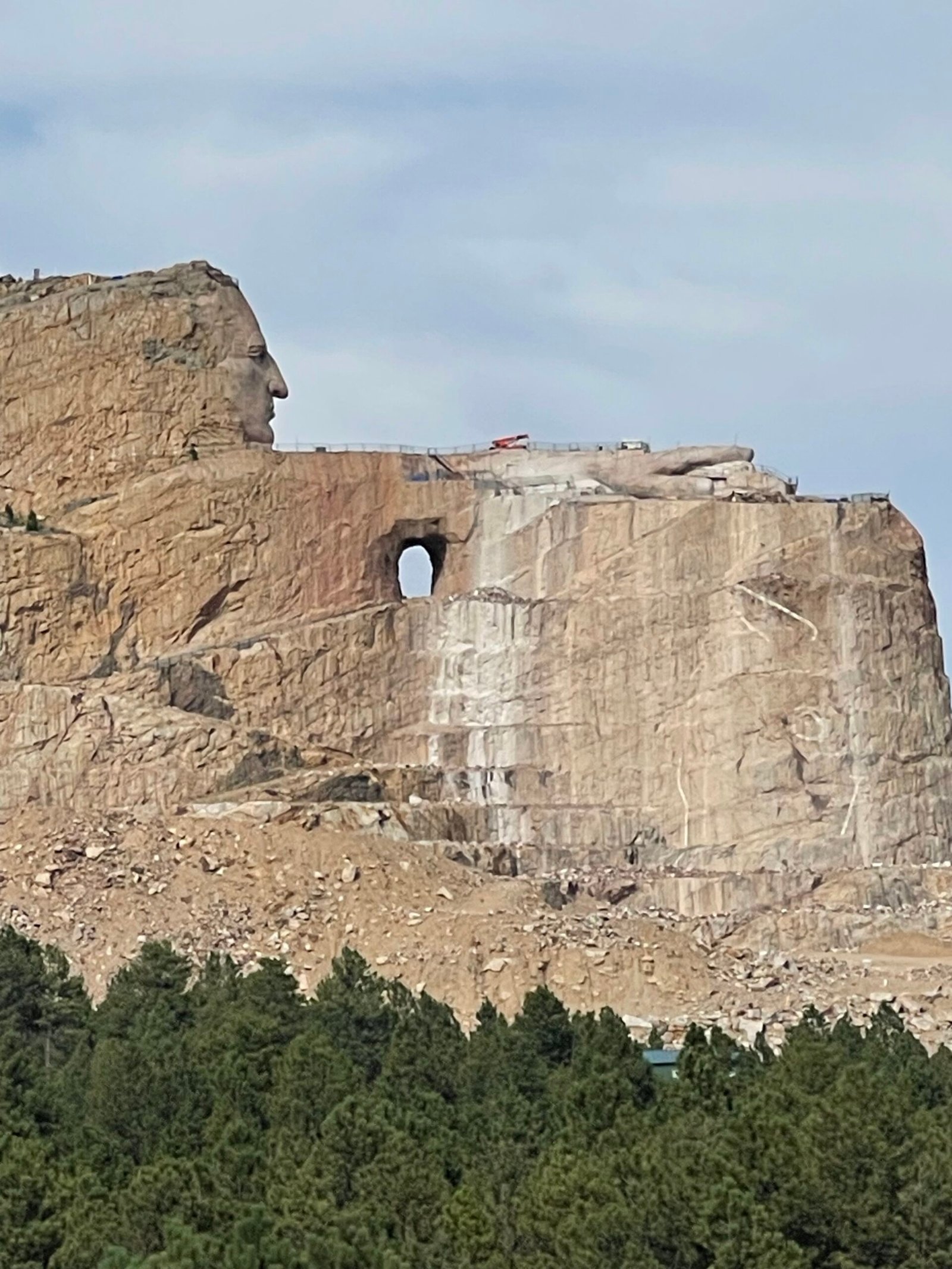
Hidden in the Black Hills of South Dakota, the Crazy Horse Memorial is becoming America’s largest monument.

The first time I saw the Crazy Horse Memorial was back in 2010 during a family RV trip across the United States. At the time, I was still young, and like most kids on road trips, I remember being excited just to see something massive carved into the side of a mountain. We had already visited Mount Rushmore National Memorial, which felt larger than life in person, but then someone told me there was another monument nearby that was planned to be even bigger.
I didn’t fully understand the scale of it back then. I just remember staring at the mountain and thinking it looked impossible.
More than a decade later, in 2023, Katie and I returned to South Dakota during one of our own trips across the country. We flew into Rapid City and immediately started exploring the Black Hills region. One of our first stops was Mount Rushmore. Even now, it’s still one of those landmarks that’s worth seeing at least once in your life. Photos really do not prepare you for finally seeing it in person.
Katie had never visited before, and watching her reaction reminded me a lot of my own first trip there as a kid. No matter how many times you’ve seen it in textbooks, documentaries, or movies, standing beneath it feels different. The scale, the history, and the engineering behind carving four presidential faces directly into granite is genuinely impressive.
But after visiting Mount Rushmore, I wanted to show her something even more surprising.
Just a short drive away sits the Crazy Horse Memorial, a monument so massive that the entire Mount Rushmore carving could fit inside the face of Crazy Horse alone.
That comparison honestly sounds exaggerated until you see it for yourself.
The Vision Behind the Monument
The Crazy Horse Memorial is dedicated to the Lakota warrior Crazy Horse, a Native American leader best known for fighting against the U.S. government during the 1800s, including his role in the Battle of the Little Bighorn in 1876. Unlike Mount Rushmore, which honors four U.S. presidents, the Crazy Horse Memorial was designed to honor Native American history and culture.
The project officially began in 1948 when sculptor Korczak Ziolkowski started carving the mountain after being invited by Lakota Chief Henry Standing Bear. The goal was to create a monument that would represent Native Americans and preserve their history for future generations.
The finished memorial is planned to show Crazy Horse riding a horse and pointing forward into the distance. According to the memorial’s vision, the gesture is tied to the quote often associated with Crazy Horse when asked where his lands were: “My lands are where my dead lie buried.”
Even though construction started over 75 years ago, the monument still appears unfinished today, which surprises many visitors. But when you understand the scale of the project, it makes much more sense.
Unlike Mount Rushmore, which received federal funding, the Crazy Horse Memorial is primarily self-funded through tourism, donations, and admissions. No major federal funding has been used for the construction itself. Because of that, progress happens slowly and carefully over decades rather than years.
And honestly, standing there in person, it becomes easier to understand why.
The mountain itself is enormous. Altering solid granite on that scale takes a tremendous amount of engineering, planning, manpower, and money. Even after all these years, the face alone is already massive enough to dominate the landscape around it.
Seeing It in Person
When Katie and I visited in 2023, one of the first things she noticed was how much larger the monument feels compared to photos online. Pictures flatten its scale, but in person, the carving stretches across the mountain in a way that’s hard to process at first.

The image shows a chalk outline of the horse.
The face of Crazy Horse has already been completed, and you can clearly see the outline of the horse and the direction the monument will eventually take. From the viewing area, you start imagining how enormous the final sculpture will be if completed fully.
What makes the experience more interesting is that the memorial is more than just the mountain carving itself.
The main visitor center includes museums, exhibits, educational displays, gift shops, and a small café overlooking the monument. Inside, there are scale models showing what the final memorial is intended to look like once completed. Those displays really help visitors understand the true scope of the project because the finished design is difficult to picture from the mountain alone.
There are also exhibits focused on Native American culture, artifacts, and history, making the location feel more educational than simply a roadside attraction.
One thing that stood out to us was learning that the long-term vision for the memorial extends far beyond the sculpture itself. The organization behind the memorial has also worked toward educational programs and scholarships for Native American students, including plans tied to expanding educational facilities in the area over time.
That broader mission gives the project a different feeling compared to many tourist landmarks. It’s not just about finishing a carving; it’s also about preserving history, culture, and education.
Why It Leaves Such a Strong Impression
Returning to the Crazy Horse Memorial as an adult made me appreciate it far more than I did as a kid in 2010.
Back then, I only saw a mountain being carved.
Visiting again in 2023, I understood the ambition behind it. This is not a small statue or a simple tourist stop. It is one of the largest sculpture projects ever attempted anywhere in the world, still actively being worked on decades after construction first began.
And while some visitors criticize how long the project has taken, seeing the monument in person changes your perspective. The amount of rock that has already been removed is staggering, and the fact that the project continues largely through self-funding makes the progress even more impressive.
It also creates a very different experience from Mount Rushmore. Mount Rushmore feels complete, polished, and historic. Crazy Horse feels alive and ongoing, almost like you are witnessing history still being created in real time.
For Katie, the contrast between the two monuments was one of the most memorable parts of the trip. Seeing Mount Rushmore first helped put the scale of Crazy Horse into perspective immediately afterward.
And honestly, that is probably the best way to experience both.
See Mount Rushmore first. Appreciate the craftsmanship and history behind it. Then drive over to Crazy Horse and realize the face alone is larger than the entire monument you just visited.
It completely changes your sense of scale.
Even after visiting many famous landmarks across the United States, the Crazy Horse Memorial remains one of the most unique places I’ve ever seen – not just because of its size, but because it still feels unfinished, ambitious, and constantly evolving decades later.



Leave a Reply